
HOZO NeoSander Review: A Palm-Sized Linear Detail Sander for Model Makers and Fine Finishing
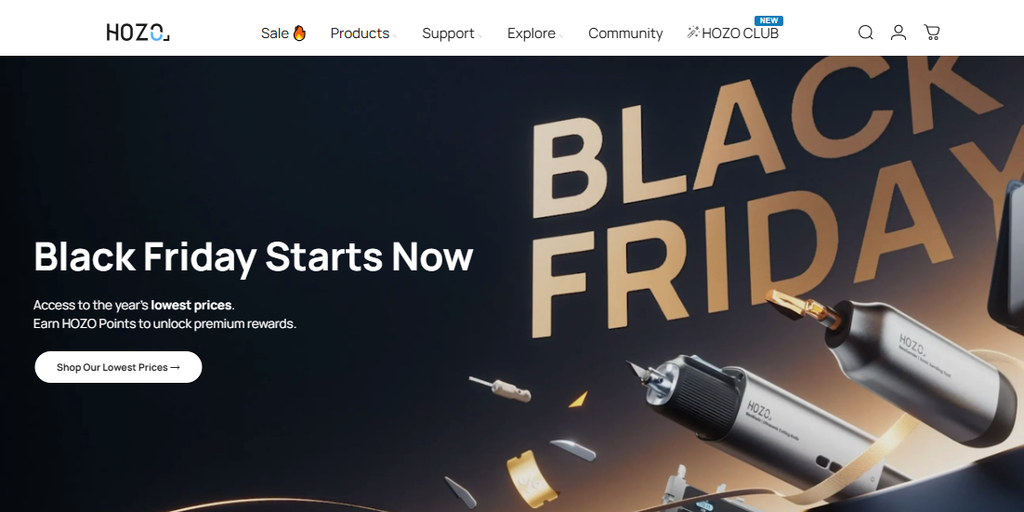
The HOZO NeoSander is a palm-sized reciprocating detail sander from HOZO Design Co., Limited, a Hong Kong company that first built its reputation on compact measuring tools and has since moved into the workshop. Sales opened on Amazon in the United States and United Kingdom on May 20, 2026, and direct sales on the HOZO website followed from June 5, 2026. The launch came after a Kickstarter campaign that raised more than two million dollars from over 14,000 backers, which is a notable result for a niche finishing accessory. The NeoSander does not try to compete with full-size orbital sanders. It is aimed at scale model builders, owners of 3D printers, woodcarvers, resin crafters, and detail-focused DIY users who spend long hours smoothing small surfaces by hand. This review looks at how the tool is built, what its specifications mean in practice, how it is priced, and where its limits show.
HOZO Background and the Road to NeoSander
HOZO describes itself as a design-led technology company, and its catalog reflects that positioning. Earlier products such as the NeoRuler and Meazor were digital measuring devices funded through crowdfunding, and the company’s own pages cite more than 40,000 active users across over 65 countries and regions. Design recognition includes a Good Design Award in 2021 and an iF Design Award in 2024 for the NeoRuler. The NeoBlade cutting tool shares a visual language with the NeoSander, and reviewers have noted that owners of one will find the other familiar. That consistency matters because HOZO sells accessories, battery packs, and bundles around a recognizable product family rather than isolated gadgets. The NeoSander extends this approach into surface finishing, a task that has traditionally relied on sanding sticks, files, and rotary tools. For a company with a measurement background, the move is logical: precision and repeatability are the same virtues that matter when removing a printed support mark from a small figure.
HOZO Linear Motion and Technical Specifications
The central engineering claim behind the NeoSander is its linear motor, which drives the sanding head back and forth at a rated 13,000 strokes per minute. Because the motion is straight rather than rotary, the pattern left on a surface is directional and easier to predict, and HOZO says this reduces the circular scratch marks common with spinning tools. Stroke length is adjustable between 0.6 and 1.8 millimeters, with a stepless slider, while output power can be varied from 0.8 to 5 watts. HOZO lists concentricity at under 0.05 millimeters and claims an 85 percent reduction in motor vibration compared with a conventional design. The company also states an IP54 protection rating and an operating temperature range of 0 to 60 degrees Celsius. Independent reviewers describe the low vibration as noticeable during long sessions, though the exact percentage remains a manufacturer figure. The adjustable stroke is arguably the most practical feature, since it allows quick shaping with a long stroke and delicate finishing with a short one without changing tools.
HOZO Design, Weight, and Handling in Use
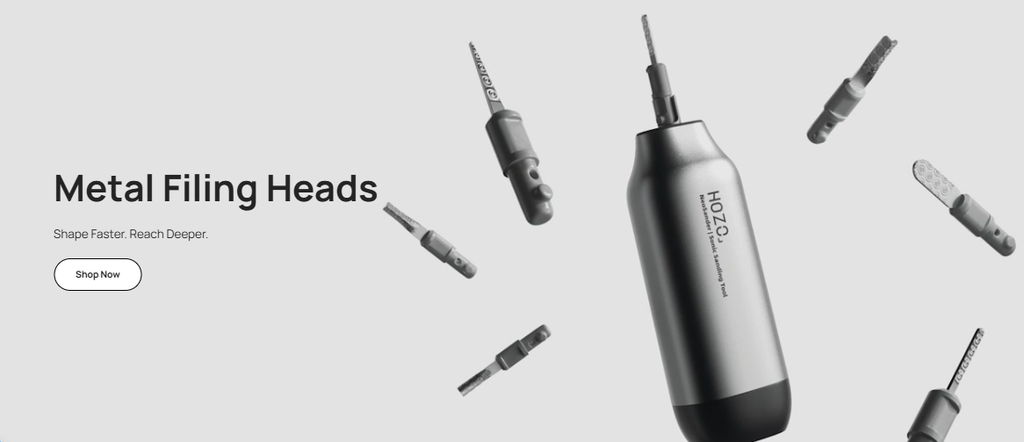
At about 89 grams without a sanding head, the NeoSander is closer to a thick marker than a power tool. The pen-style body rests in one hand, which suits work on miniatures where the other hand must hold or steady the part. A clicking power button and an LED indicator report battery status through color: blue for a full charge, orange for a medium level, and red below 20 percent. Speed and intensity are controlled with a slider rather than preset modes, so adjustments happen while the tool is running. Reviewers who tested the NeoSander on resin models and 3D prints describe it as controlled rather than aggressive, designed to remove small imperfections instead of tearing through material. One reviewer also pointed out that sanding even at this scale produces dust, so a covered workspace and a mask remain sensible. The compact size has a trade-off: the NeoSander is poorly suited to broad surfaces, where a larger sander would finish far faster than any pen-format tool.
HOZO Sanding Heads, Grits, and Optional Saw Collection
A reciprocating sander is only as useful as the shapes it can reach, and HOZO addresses this with eight interchangeable head profiles covering flat areas, edges, corners, and curves. Eight grit options run from coarse shaping through to fine polishing, and the Premium Combo supplies organizer racks with labeled grits so that pre-papered heads can be swapped quickly instead of re-papering a single head each time. Adhesive-backed sheets attach to the heads, and HOZO’s documentation suggests warming a lifted edge with a hair dryer to set the adhesive. The system also accepts an optional Saw Collection, and fitting a saw blade in place of a sanding head turns the tool into a controlled precision cutter for small parts. This modularity broadens its role, although it raises ongoing costs. Reviewers report that sanding paper wears faster than they would like, and the replacement heads and sheets are proprietary, which ties long-term running costs to HOZO’s own consumables.
HOZO Battery Life and Charging Behavior
The NeoSander uses a 3.7-volt, 1,100 mAh battery, and HOZO rates runtime at 45 minutes under full load or up to 240 minutes in typical stop-and-start use. Reviewers who tested the tool reported results consistent with those figures, and one noted that roughly 30 minutes of charging delivered about 40 minutes of high-power sanding. Charging works through USB-C at 5 volts and 1 amp, with Power Delivery compatibility, or through an included charging dock in the Premium Combo, which brings the battery from 10 to 90 percent in around half an hour. A practical detail is that the tool can run while plugged in, so an empty battery during a session is an inconvenience rather than a stoppage. For modelers who work in short bursts between painting and assembly, the stated typical-use runtime should cover several sessions per charge. Heavy continuous sanding of larger parts would drain the battery noticeably faster, which is where the pass-through charging proves most useful.
HOZO NeoSander Pricing and Available Configurations
Pricing varies by configuration and retailer. The standard NeoSander lists at a regular price of $69.99 in the United States and £69.99 in the United Kingdom, and a Black Friday and Cyber Monday promotion on Amazon from November 19 to December 14, 2026 lowers it to $55.99 and £55.99. The Premium Combo, which bundles the tool with accessories, the dock, and a full collection of sanding heads, carries a manufacturer’s suggested price of $169, and HOZO ran a 20 percent discount on its own site earlier in the year that brought it to $135.20. Third-party sellers list the same product at widely differing prices, so buyers comparing offers should check the seller and the included contents. One reviewer concluded that the higher price is justified for hobbyists who value the time saved on tedious preparation, while acknowledging that casual users may find the cost hard to defend. HOZO itself describes the Premium Combo as the better value for anyone who needs the full workflow.
HOZO NeoSander Market Position and Suitable Users
Within the broader tool market, the NeoSander occupies a narrow but active category of compact precision finishing devices. Its closest alternatives are manual sanding sticks, which cost little but demand time and steady pressure, and rotary micro-tools, which work quickly but can gouge delicate parts. The NeoSander sits between them, trading a higher purchase price for consistency and reduced fatigue. Its strongest case is with 3D print post-processing, scale modeling, resin work, and fine woodworking, where support marks, seams, and joints need controlled removal. Weaker points include the proprietary consumables, the limited usefulness on large surfaces, and a cost that exceeds what an occasional crafter might spend. The company’s wider catalog, including the NeoBlade and measuring tools, suggests a continuing push toward connected workshop accessories, and the NeoSander fits that direction as a purpose-built, well-documented tool that does one job competently for the audience it targets.