
Ulefone Armor 29 Pro Thermal: Thermal Imaging, Battery Capacity, and Field Applications
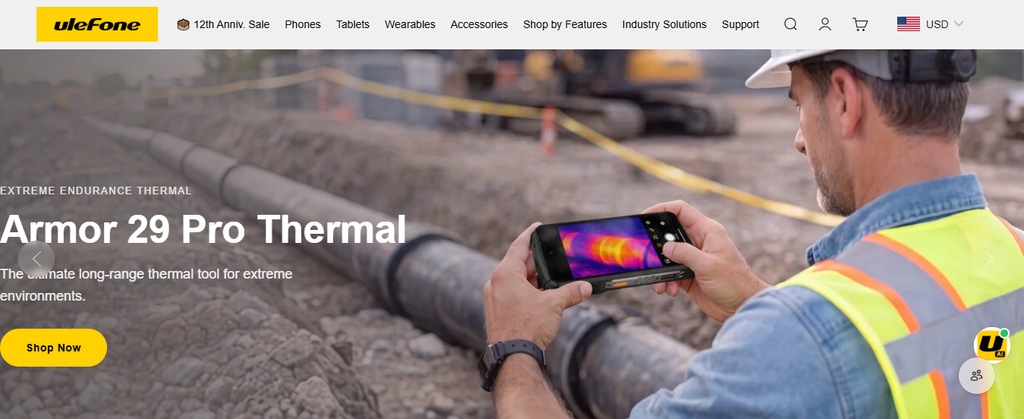
The Ulefone Armor 29 Pro Thermal is a rugged smartphone designed to combine everyday mobile communication with specialist tools for outdoor work, equipment inspection, and demanding environments. Its defining feature is the integrated ThermoVue T2 thermal imaging system, which displays temperature differences that cannot be seen with an ordinary camera. The device also combines 5G connectivity, a large battery, a high-capacity memory configuration, night photography capabilities, and a high-output LED light. Rather than functioning solely as a conventional smartphone, the Armor 29 Pro Thermal brings several field-oriented functions into one handheld device. This combination is relevant to technicians, maintenance personnel, outdoor professionals, and users who need access to thermal information while remaining connected. Its specifications also illustrate how Ulefone approaches rugged mobile hardware by integrating specialist instruments alongside standard communication, photography, navigation, and application features.
Ulefone Armor 29 Pro Thermal and Its Core Capabilities
The Armor 29 Pro Thermal combines a MediaTek Dimensity 7400 processor with 5G mobile connectivity and an Android-based software environment. The official product information lists 32GB of combined memory, consisting of 16GB of physical RAM and an additional 16GB of virtual memory, alongside 512GB of internal storage. Expansion support is advertised up to 2TB, although a compatible memory card may need to be purchased separately. This configuration accommodates applications, photographs, recorded thermal images, downloaded maps, and work-related documents. The handset’s main distinction is the inclusion of dedicated thermal imaging hardware rather than relying on an external accessory. Its other components support conventional smartphone activities such as messaging, web browsing, navigation, media playback, and photography. The result is a device intended for users whose daily work may require both ordinary mobile computing and access to additional environmental information.
Ulefone Thermal Imaging for Inspection Tasks
The integrated ThermoVue T2 thermal camera is one of the most specialised components of the Ulefone Armor 29 Pro Thermal. According to Ulefone’s published specifications, the thermal sensor offers a resolution of 640 × 512 pixels, a frame rate of 25Hz, a field of view of 56 degrees by 42 degrees, and a temperature sensitivity below 40 millikelvin. Its stated measurable temperature range extends from minus 20 degrees Celsius to 550 degrees Celsius, with an advertised accuracy of approximately plus or minus 2 degrees Celsius under specified conditions. These measurements describe the sensor’s capabilities, not a guarantee that every real-world reading will achieve the stated accuracy. The preinstalled ThermoVue Pro application provides the software interface for viewing thermal information. Potential applications include identifying unusual heat patterns in electrical equipment, checking temperature variations around machinery, inspecting building surfaces, and examining components during maintenance. Thermal imagery indicates surface temperature patterns and should not be treated as a substitute for specialist diagnostic instruments, appropriate safety procedures, or professional interpretation.
Ulefone Camera Functions for Day and Night Work

Alongside thermal imaging, the Ulefone Armor 29 Pro Thermal includes conventional rear cameras and a front-facing camera for photography and video communication. The published configuration identifies a 50-megapixel main camera, a 50-megapixel ultra-wide camera, and a 64-megapixel night-vision camera. The front camera is specified at 32 megapixels. Each camera serves a different practical purpose: the main camera captures ordinary scenes and documentation, the ultra-wide camera accommodates broader subjects, and the night-vision camera supports image capture in low-light conditions. These functions can be useful for recording equipment layouts, documenting maintenance work, photographing outdoor locations, or capturing reference images after dark. Thermal images and conventional photographs represent different types of information, so one should not be interpreted as a replacement for the other. Results from regular cameras depend on illumination, focus, movement, and software processing, while night-vision performance depends on the camera’s infrared system and operating environment.
Ulefone Battery Design and Integrated Lighting
Power capacity is another central part of the Ulefone Armor 29 Pro Thermal’s design. Ulefone advertises a 21,200mAh equivalent battery configuration, described as equivalent to a 10,600mAh battery at a different voltage arrangement. This distinction matters when comparing the advertised capacity with phones that list battery capacity at a different nominal voltage. The device supports 120W wired charging according to its product specifications, while charging speed in practice can vary with temperature, battery level, charger compatibility, and usage. Its substantial battery is intended to support extended periods away from a conventional power outlet, including outdoor work and inspection sessions. The handset also incorporates a versatile LED light rated at up to 1,000 lumens, providing an integrated source of illumination for work areas, campsites, and other dark environments. A dedicated light can reduce the need to carry a separate small torch for routine tasks, although appropriate work lighting may still be required for detailed or hazardous operations.
Ulefone Display, Processing, and Everyday Operation
The Armor 29 Pro Thermal uses a 6.67-inch AMOLED main display, with a secondary display integrated into the device’s design. The main screen provides the viewing area for thermal imagery, photographs, maps, technical documents, and ordinary smartphone applications. AMOLED technology produces individually illuminated pixels, allowing dark interface elements and high-contrast imagery to be displayed without a conventional full-screen backlight. The secondary screen can provide access to selected information or functions without requiring the main display to remain active, depending on the supported software and configuration. Processing is handled by MediaTek’s Dimensity 7400 platform, which supports the device’s combination of communication, application use, imaging, and multitasking. The listed physical memory and storage capacity provide room for larger applications and locally stored work material, while 5G support enables compatible high-speed mobile connections in areas with suitable network coverage. Network bands, carrier support, and regional configurations should be checked before purchase.
Ulefone Rugged Construction and Environmental Protection

The Ulefone Armor 29 Pro Thermal is built around a reinforced chassis intended for use in environments where ordinary consumer smartphones may face greater exposure to dust, moisture, and accidental impacts. Ulefone lists IP68 and IP69K protection alongside MIL-STD-810H-related durability claims for its rugged product range. IP68 indicates protection under specified dust and water-immersion test conditions, while IP69K relates to resistance under defined high-pressure, high-temperature water-jet testing. MIL-STD-810H refers to a collection of environmental test methods; it should not be interpreted as a universal guarantee against every possible drop, vibration, temperature extreme, or workplace hazard. The manufacturer’s detailed model-specific test conditions remain important when assessing suitability for a particular task. Water resistance may diminish through wear, and damage to seals or connectors can affect protection. Charging ports and accessories also require appropriate handling, especially after exposure to moisture.
Ulefone Availability, Pricing, and Practical Suitability
The Ulefone Armor 29 Pro Thermal occupies a specialised segment of the rugged smartphone market because it combines a thermal sensor, night-vision photography, a large battery, integrated lighting, and modern mobile connectivity. Its usefulness depends on whether these features match the user’s actual requirements. Building inspectors may value thermal imaging for preliminary checks of temperature variation, while maintenance teams may use it as a supplementary screening tool when investigating equipment that appears unusually hot. Outdoor users may prioritise battery capacity, lighting, navigation, and resistance to environmental exposure. Buyers who mainly need calls, messaging, and ordinary photography may find the device’s specialised hardware and substantial physical size unnecessary. Ulefone lists the model through its official online store, but stock status, regional availability, shipping terms, warranty coverage, and final pricing can change.