
Betty Mills Review: Product Selection, Purchasing Experience, and Business Applications
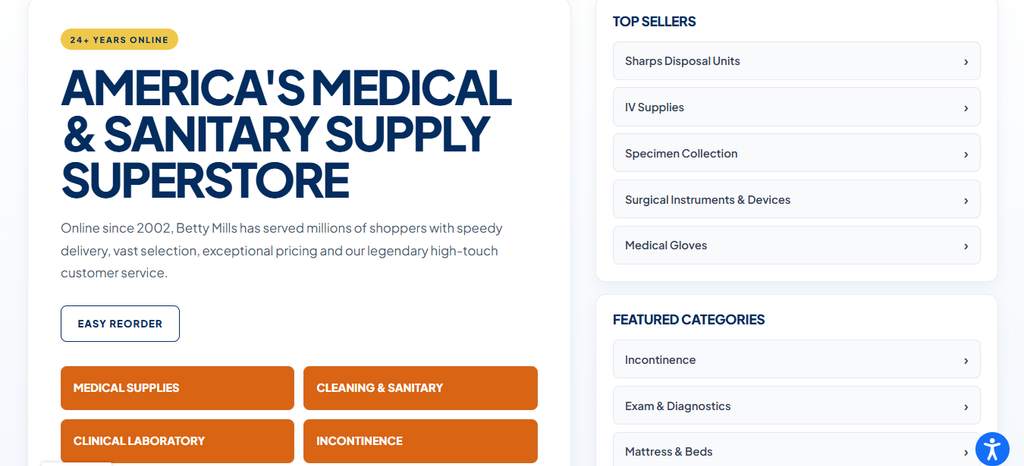
Betty Mills is an online supplier of medical, cleaning, sanitary, facility maintenance, and workplace products, serving organizations and individual buyers through a centralized e-commerce platform. Operating online since 2002, the company has developed a catalog that addresses recurring purchasing requirements across healthcare environments, commercial facilities, offices, educational institutions, and foodservice operations. Rather than concentrating on a single manufacturer or product category, Betty Mills provides access to supplies from multiple established brands, allowing buyers to investigate different options within one shopping environment. Its medical and sanitary supply platform is particularly relevant to organizations that regularly purchase disposable medical products, personal protective equipment, cleaning chemicals, restroom essentials, and patient-care items. The overall proposition combines product discovery, online ordering, account management, and customer assistance within a single service.
Betty Mills Product Selection and Catalog Organization
Product breadth is one of the defining characteristics of Betty Mills. Its online catalog includes medical supplies, clinical laboratory products, rehabilitation equipment, patient-care essentials, incontinence products, scrubs, workwear, cleaning materials, and food and breakroom supplies. Within cleaning and sanitary products, buyers can explore categories covering disinfectants, hand sanitizers, gloves, paper products, dispensers, mops, floor-care equipment, waste receptacles, and facility maintenance accessories. The medical selection includes items such as examination supplies, specimen collection products, sharps disposal units, wound-care materials, and medical gloves. This organization accommodates purchasing needs that differ considerably in purpose, quantity, and technical requirements. Category-based browsing provides a practical starting point for users who know the general type of supply they require but have not identified a particular model. Search functionality offers another route for locating products by name or relevant terms.
Betty Mills Medical Supplies and Healthcare Applications
Healthcare purchasing is a significant part of the Betty Mills offering, with products intended for clinical facilities, care providers, laboratories, and related organizations. The platform lists supplies across several practical areas, including examination and diagnostic procedures, specimen collection, patient hygiene, wound care, rehabilitation, and medical waste handling. These categories address different stages of routine care and facility operations, from preparing examination spaces to maintaining hygiene and organizing patient-support activities. Disposable products such as gloves and other frequently replenished consumables are especially relevant to institutions managing regular inventory turnover. Betty Mills also lists equipment and patient-care products, including beds, mattresses, and mobility-related items, broadening its usefulness beyond small disposable supplies. Centralizing these purchasing categories may help procurement staff compare available products and coordinate orders for different departments. Nevertheless, healthcare purchasing requires more scrutiny than ordinary consumer shopping.
Betty Mills Cleaning and Sanitation Product Features
Cleaning and sanitation supplies form another substantial part of the Betty Mills catalog, making this area relevant to offices, schools, healthcare facilities, hospitality businesses, and commercial property managers. Available categories include cleaning chemicals, disinfectants, microfiber products, mops and buckets, brushes, floor-care equipment, waste liners, restroom paper, soap dispensers, and personal hygiene products. This range reflects the different tasks involved in maintaining a facility, including routine surface cleaning, restroom replenishment, waste management, and specialized floor maintenance. Buyers can investigate products according to their operational purpose rather than treating cleaning as a single purchasing category. For example, a facility may need separate solutions for high-traffic flooring, hand hygiene stations, washrooms, and general-purpose surface care. Access to related consumables and equipment through one supplier can simplify the initial product search. However, chemical products should be evaluated according to their labels, dilution instructions, surface compatibility, and applicable safety documentation.
Betty Mills Website Navigation and Ordering Experience
The Betty Mills website is structured around product categories, search tools, individual product listings, and a shopping cart-based ordering process. Buyers can browse categories or enter keywords to locate items, then review the available listing information before adding suitable products to an order. This conventional e-commerce structure is familiar to many users and supports purchasing without requiring direct contact with a sales representative for every routine transaction. Product categorization is particularly useful when assembling orders that contain supplies for multiple operational areas. Account-related features listed on the website include order history, tracking, returns, and an easy-reorder option, which can help repeat customers manage recurring purchasing activities. These tools are potentially valuable for businesses that frequently replenish standard consumables and need to reference previous transactions. Their practical benefit depends on the accuracy of product identification and the consistency of the items being reordered.
Betty Mills Pricing, Order Management, and Delivery
Pricing and fulfillment are important considerations for organizations that purchase supplies repeatedly rather than occasionally. Betty Mills displays prices on individual product listings, allowing buyers to examine costs while comparing available options. The website also advertises free shipping on thousands of items and indicates that many deliveries arrive within one to three days. These statements describe the company’s published service offering, not a guarantee that every product or destination will receive identical treatment. Actual costs can depend on the item, order conditions, shipping eligibility, and other details presented during purchasing. Buyers should review the final checkout information before treating a displayed item price as the complete cost of acquisition. Pack sizes and units of sale also matter because a case price cannot be compared directly with a single-unit price without accounting for quantity. For procurement teams, evaluating the cost per usable item or application can provide a more meaningful comparison than looking at headline prices alone.
Betty Mills Customer Support and Purchasing Assistance
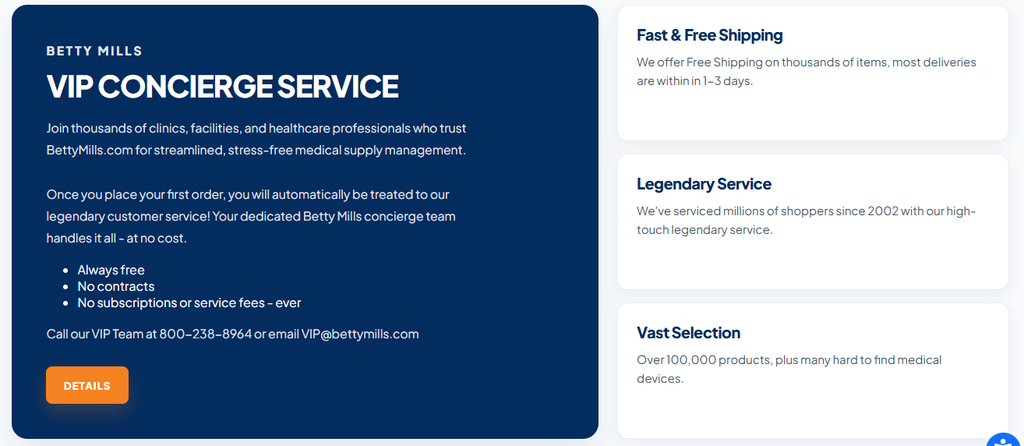
Customer assistance is an important consideration when purchasing supplies that have technical specifications, unusual dimensions, or specialized applications. Betty Mills provides support for order questions, product inquiries, returns, and account-related matters through its customer service resources. The company publishes a toll-free telephone number, 1-800-238-8964, and the email address support@bettymills.com for customer assistance. Its website also provides a help center covering topics such as order tracking, returns, payment methods, shipping policies, cancellations, and account setup. These resources offer buyers different ways to resolve issues that may arise during the purchasing process. For organizations managing recurring supply orders, access to product assistance can be particularly useful when identifying an appropriate item or clarifying a listing before purchase. The company also advertises a VIP concierge service for healthcare professionals and facilities, describing it as a free service without contracts or subscription fees.
Betty Mills Value for Businesses and Everyday Buyers
Betty Mills is most relevant to buyers who need access to a varied range of operational supplies through one online purchasing channel. Healthcare facilities can investigate medical consumables, patient-care products, and hygiene essentials, while cleaning teams can source chemicals, paper products, dispensers, and maintenance equipment. Schools, offices, hospitality operations, and other organizations may also find relevant products across the facility and breakroom categories. The breadth of the catalog creates opportunities to consolidate some purchasing activities, particularly when a buyer needs products for several departments or recurring maintenance tasks. Small businesses may appreciate the ability to research individual products without maintaining separate relationships with numerous suppliers for every category. Larger organizations, meanwhile, may benefit from order histories and repeat-order tools when managing frequently purchased items. Individual household buyers can also explore products listed for personal or domestic use, although the overall selection and ordering structure are especially suited to broad supply purchasing. The platform’s limitations are equally important to consider. A large catalog can require additional comparison, and a single supplier may not offer the most appropriate price, delivery arrangement, or technical specification for every item. “`